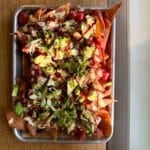
Poke Nachos
These spicy tuna poke nachos are the best possible version of an appetizer I had at a restaurant a decade ago. I've been mentally recipe testing it ever since, and I'm so happy with the flavor-packed, umami-forward result. Layers of crispy fried wonton chips, perfectly calibrated spicy tuna poke, three different sauces, edamame, creamy avocado, and furikake make for a super-satisfying bite.
Servings: 4
Ingredients
For the wonton chips
- 25 square wonton wrappers
- Safflower oil for frying
- ½ teaspoon fine sea salt
For the spicy tuna
- 1 pound sushi-grade yellowfin tuna diced
- ½ small shallot very thinly sliced
- 4 teaspoons reduced-sodium tamari
- 1 tablespoon toasted sesame oil
- ⅛ teaspoon chili flakes
- 2 scallions, white and green parts thinly sliced, divided
For the sauces
- ¼ cup Kewpie mayo divided
- 2 teaspoons sriracha
- 2 teaspoons wasabi paste
- 1 to 2 teaspoons water if needed
For the nachos
- ½ cup shelled edamame
- 1 Hass avocado diced
- 2 tablespoons eel sauce
- 1 tablespoon furikake
Instructions
Make the wonton chips
- Cut the wonton wrappers in half on the diagonal to make 50 triangles.
- Pour the oil to a depth of about 1 1/2 inches into a heavy, medium-sized pot. I like to use my 3-quart Dutch oven — it retains heat well and is the right size to allow for some bubbling without requiring a shocking amount of oil. Heat the oil to 360°F/182°C.
- In batches of about six to eight at a time, drop the wonton wrappers into the hot oil and fry, flipping each once during the process, until golden brown. This should take about 90 seconds to two minutes per batch. Remove chips with a strainer, carefully shaking off any excess oil, and transfer to a wire-rack- or paper-towel-lined rimmed baking sheet.
- Right away, sprinkle each batch with a little bit of the fine sea salt.
Make the spicy tuna poke
- Into a large mixing bowl, add the diced tuna, sliced shallot, tamari, toasted sesame oil, chili flakes, and half of the sliced scallions. Give it a gentle stir until everything is mixed well.
Make the sauces
- Divide the mayo into two small bowls.
- Add the sriracha to one bowl and the wasabi paste to the other. Mix each sauce until smooth. The sriracha mayo should be thin enough to drizzle, but depending on your wasabi paste, you may need to stir in a teaspoon or two of water to reach a drizzling consistency.
Assemble the nachos
- Arrange the wonton chips on a serving platter. Top with the poke, edamame, and diced avocado. Drizzle the sriracha mayo, wasabi mayo, and eel sauce overtop. Sprinkle with the remaining scallions and the furikake. Serve right away.
Notes
For the chips
- Wonton wrappers are thinner and more delicate than what gets sold (in the U.S. at least) as dumpling wrappers. They're made from wheat flour and sometimes have egg in the dough, though the ones I've used here do not. They're typically square, and you'll slice them in half on the diagonal (you can cut the whole stack at once) to make triangle-shaped chips.
- Safflower oil is my high-smoke-point, neutral-tasting vegetable oil of choice. You can substitute another oil that has similar properties, such as canola, sunflower, peanut, corn, or vegetable oil blend.
- Yellowfin tuna is also called ahi. (In Hawaii, ahi also includes bigeye tuna.) Yellowfin is tender, mild and fresh-tasting, and pretty widely available.These days, thanks to poke's popularity, my local fish markets all sell yellowfin tuna labeled "tuna for poke." They'll usually even dice it for you if you like. Hopefully the same is true for you. If not, you can source flash-frozen tuna online. Please refer to the FAQ section of the blog post for more details.
- A little bit of toasted sesame oil adds a deep, gorgeous flavor to the tuna. You can use regular toasted sesame oil or the kind with chili, depending on what spice level you’re going for. Don't use the untoasted sesame oil that's meant for cooking — it lacks the special flavor of the toasted variety.
- You can use any lower-sodium Japanese-style soy sauce, but tamari is my personal favorite for its smooth flavor profile and deep umami. (It's also gluten-free, but wonton wrappers aren't, so that's not the goal here.)
- There's something about slicing scallions on a deep angle that elevates a whole dish. It's such a silly and simple upgrade, but I really went for it here!
- Kewpie mayo is creamier, tangier, and more umami-fied than American mayo. It’s made with egg yolks instead of whole eggs, has a thinner consistency that makes it popular as a salad dressing base, and, not gonna lie, it has a little MSG in it. It's so good, and I'm really happy it's becoming easier to get in supermarkets. If you can't find it locally, you can order it online.
- In general, I always try to buy real wasabi paste if possible (the stuff made from actual Japanese wasabi as opposed to American horseradish and green dye). It has a mellower and generally just better flavor. That said, don't stress about it in this recipe. Poke nachos aren't that serious.
- Hass avocados are creamy and buttery and fabulous. If, like me, you don’t live in an area where avocados grow, you’ll still probably be able to find them at various stages of ripeness in your local stores. If you do live somewhere with plenty of access to different avocado varieties, feel free to use your favorite creamy cultivar.
- You can buy shelled edamame in the freezer section and steam them yourself, but sometimes I just use pre-cooked ones from a grocery store salad or sushi bar.
- I giggle every time I say eel sauce (also called unagi sauce or unagi sushi sauce), but it's such a satisfying combination of sweet, savory, and drizzle-able. No eels are harmed in the making of this product, in case you were wondering. It's so named because it's used to flavor eel (unagi) sushi. I found it in my local grocery store (not to brag), but if you can't, you can buy it online.
- Furikake is a fabulous Japanese condiment that I find myself sprinkling on everything from tomato sandwiches to popcorn (to poke nachos). It usually contains a blend of dried seaweed, sesame seeds, bonito flakes or a vegetarian substitute like musrhoom, salt, and little sugar.
About frying vs. baking the chips
Frying these wonton chips is no big deal, I promise. You'll just be doing a few at a time, and since they don't have a super-high moisture content, they're well-behaved in the fryer. That said, if you prefer, you can bake or air fry the chips instead. They'll be flatter, won't have the charming little bubbles, and won't brown as evenly or appealingly, but they will get the job done, and I won't judge ya! To bake, line a couple of rimmed baking sheets with parchment and spray generously with a good-quality cooking spray. Arrange the cut wonton wrappers in an even single layer, spray again, sprinkle with the salt, and bake at 400°F/205°C for 5-10 minutes, until crisp and browned. To air fry, follow the manufacturer's instructions for your particular model.Advance prep
You can fry the chips, make the poke, and make the sauces earlier in the day. Assemble the nachos right before serving. The chips will lose their crispness as they mingle with the toppings, so while you can technically keep leftovers in an airtight container in the fridge for a day or two, and the flavors will still be great, you won't really have nachos anymore. I'd recommend making only as much as you plan to eat at serving time. The recipe is easily halved if that's more your speed.Nutrition
Calories: 547kcal | Carbohydrates: 37g | Protein: 35g | Fat: 28g | Saturated Fat: 5g | Polyunsaturated Fat: 11g | Monounsaturated Fat: 11g | Trans Fat: 0.03g | Cholesterol: 53mg | Sodium: 1276mg | Potassium: 737mg | Fiber: 5g | Sugar: 3g | Vitamin A: 2647IU | Vitamin C: 9mg | Calcium: 66mg | Iron: 4mg
QR code
Scan this QR code with your phone's camera to view this recipe on your mobile device.
