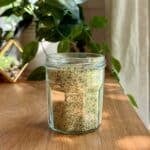
Basil Salt
If you've got a bumper crop of basil, make this no-cook, two-ingredient basil salt and preserve a little bit of summer all year long. It's great sprinkled on tomatoes, salads, cooked vegetables, proteins, and more. I have provided both volumetric and weight measurements, because America, but weigh if you can — both tender herbs and kosher salt are tricky to measure volumetrically. Makes about 2 1/2 cups.
Servings: 480 quarter-teaspoon servings
Equipment
- Kitchen scale (optional, but really useful)
- Food processor (mine is 14 cups — it's okay if yours is smaller)
Ingredients
- 2 ½ cups gently packed basil leaves and tender stems
- 2 cups kosher salt I use Morton
Instructions
- Wash the basil and dry it completely with paper towels. This step is important, so don't rush it. If you've got an extra day to let the basil dry thoroughly before proceeding, use that time. If not, that's okay.
- Add the basil to the food processor and top with the salt.
- Pulse until the mixture is a relatively uniform green. The salt should be fairly fine in texture, but not obliterated.
- Spread out the basil salt in a wide, flat baking dish that's not made of a reactive metal. (Glass, ceramic, or good-quality stainless steel is fine — avoid aluminum.) Cover with parchment paper and let sit on the countertop for several days, until thoroughly dried, stirring once or twice a day. As you can see from the video and process photos, the color will mute as the basil dries.
- Store in an airtight container at room temperature.
Notes
Ingredient notes
- This is a recipe to make when you've got plenty of fresh basil at its absolute peak. Since it's the only real flavor, and crops can vary in so many ways, sample it and make sure you really like the taste of this particular basil a lot before proceeding. (If not, make pesto, which gives you a million levers to pull and adjust.)
- This recipe works best with kosher salt because it starts out fairly large and has a delicate structure than will break up nicely in the food processor. Both Morton and Diamond Crystal work just fine, but for reference, I used Morton when testing my favorite ratios of salt to basil. Due to their different shapes (and therefore how much salt fits into a cup measure), Morton is much saltier than Diamond Crystal when measuring by volume. If you're not in North America and have a hard time finding kosher salt, I'd recommend a large, flaky sea salt, which should also break up nicely in the food processor without turning to dust.
Process notes
I really prefer to let basil salt dry at room temperature, since it preserves as much as possible of the herb's complex flavor profile. If you have a dehydrator, you could use that instead on a low setting (max about 115°F/46°C). I don't recommend drying basil salt in the oven, but if you must, keep it on the lowest setting, usually 200°F/93°C.Storage
Once fully dried, the life span is more or less indefinite. We store ours in an airtight container and tend to use it before the next year's basil is ready.Nutrition
Serving: 0.25teaspoon | Calories: 0.03kcal | Carbohydrates: 0.003g | Protein: 0.004g | Fat: 0.001g | Sodium: 472mg | Potassium: 0.5mg | Fiber: 0.002g | Vitamin A: 7IU | Vitamin C: 0.02mg | Calcium: 1mg | Iron: 0.01mg
QR code
Scan this QR code with your phone's camera to view this recipe on your mobile device.
