

This post may contain affiliate links. Learn more.
At a glance
- What it is: My mom’s recipe for salt flavored with basil, which you can use all year long
- What makes it special: This easy recipe elevates fresh tomatoes, a simple salad, cooked vegetables, a wide variety of proteins, and more. The method flavors the salt itself and doesn’t use heat, so it retains maximum flavor.
- How to make it: Wash and thoroughly dry fresh basil, pulse it in a food processor with kosher salt, and let the mixture dry completely.
Why you’ll love this recipe

For decades, my mom’s basil salt has been improving meals throughout our family’s households. Its highest and best use is in the Ann Gratzer big green salad, which I’ll share soon, where she halves and basil-salts tiny tomatoes and lets them sit for a bit, and then also uses basil salt in the tossing of the salad overall.
But you can use it anywhere you’d like to sprinkle a little of the essence of summer.
This recipe makes a nice big batch that keeps all year long, and I’ve never met (or, at any rate, developed a long-term relationship with) anyone who was sad to receive a little jar of it.
Hope you love it.
BTW, if you’ve happened upon this page in the colder months, try this herb salt instead.
Video: How to make basil salt
What you’ll need
Here’s a peek at the two simple ingredients you’ll need to make this recipe. I highly recommend weighing your ingredients rather than measuring by volume if possible, since tender herbs and kosher salt each present their own challenges to measuring by volume. (Here’s my favorite kitchen scale, hint hint.) That said, your basil salt will taste great even if you end up with wildly different ratios than I recommend — so don’t avoid making this recipe if you’re not yet on team scale.
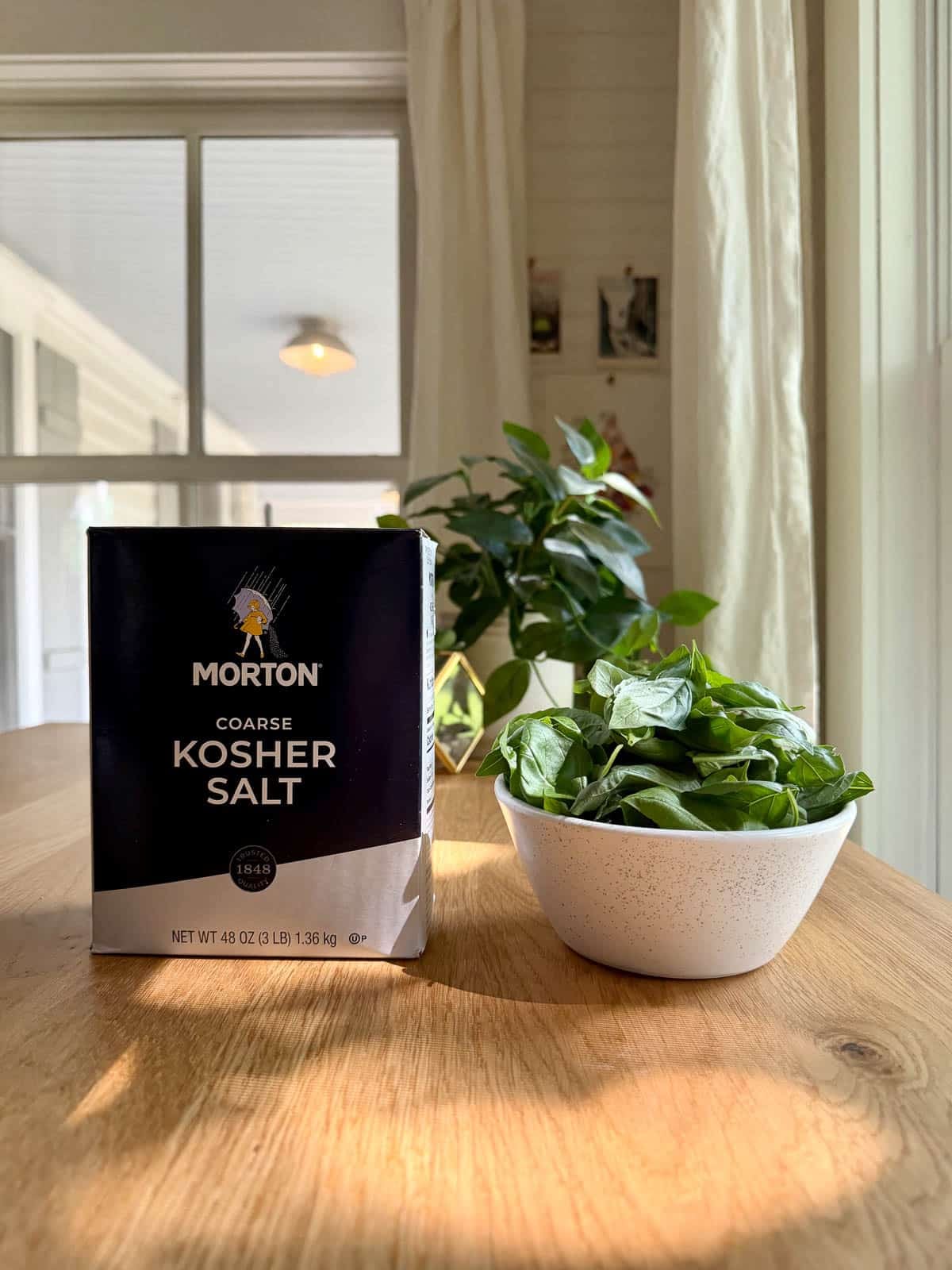
- This is a recipe to make when you’ve got plenty of fresh basil at its absolute peak. Since it’s the only real flavor, and crops can vary in so many ways, sample it and make sure you really like the taste of this particular basil a lot before proceeding. (If not, make pesto, which gives you a million levers to pull and adjust.) Not to brag, but the basil pictured here was grown by my daughter! This whole basil salt thing is a real family affair for us, I’m realizing.
- This recipe works best with kosher salt because it starts out fairly large and has a delicate structure than will break up nicely in the food processor. Both Morton and Diamond Crystal work just fine, but for reference, I used Morton when testing my favorite ratios of salt to basil. Due to their different shapes (and therefore how much salt fits into a cup measure), Morton is much saltier than Diamond Crystal when measuring by volume. If you’re not in North America and have a hard time finding kosher salt, I’d recommend a large, flaky sea salt, which should also break up nicely in the food processor without turning to dust.
How to make it
Here’s an overview of what you’ll do to make a fabulous batch of basil salt. You can see the steps in action in the video that accompanies this post, and get all the details in the recipe card below.
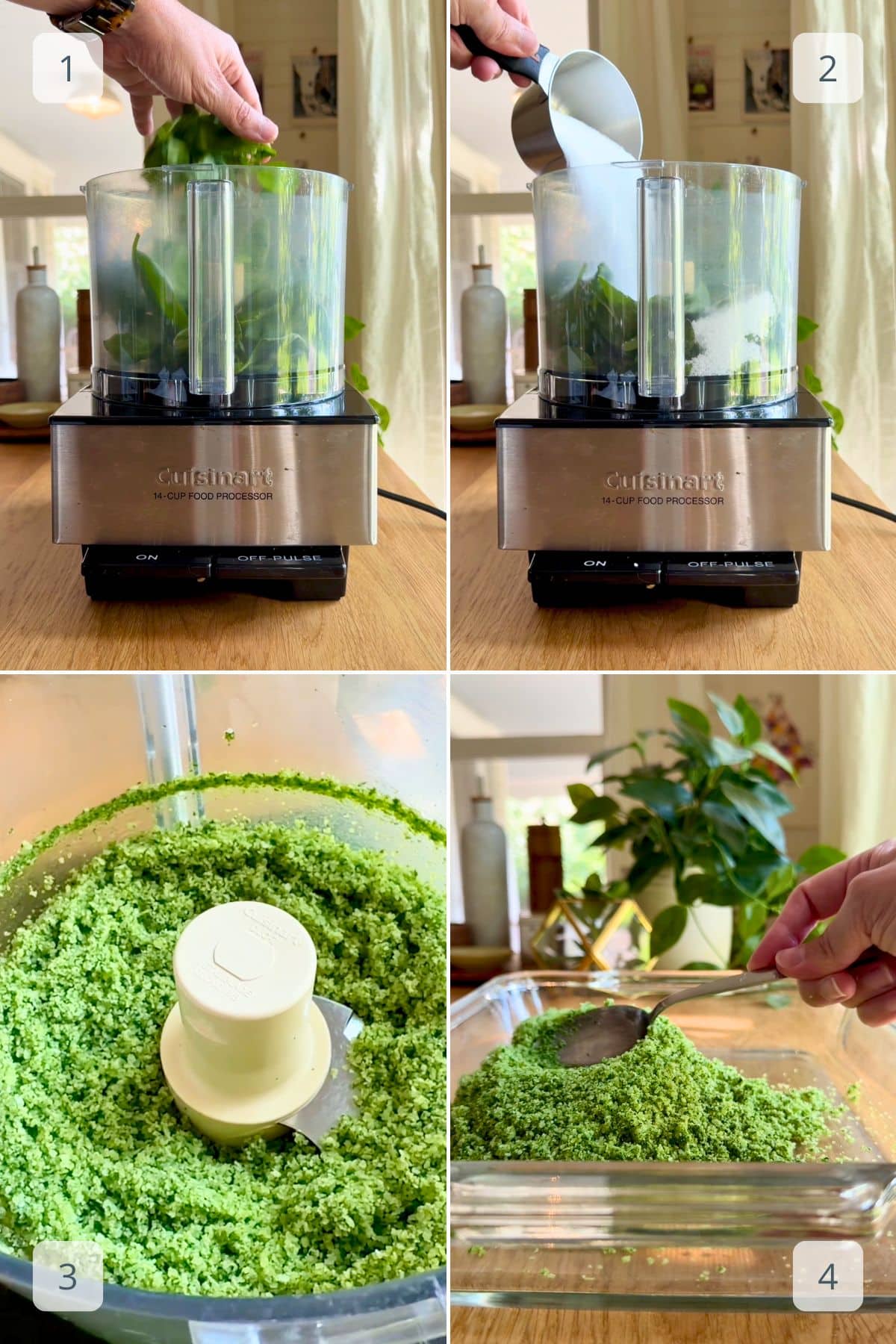
- Wash the basil, dry completely, and add to the food processor.
- Add the salt.
- Pulse until it’s a relatively uniform green. The salt should be fairly fine in texture, but not obliterated.
- Spread out the basil salt in a wide, flat baking dish, cover with parchment, and let sit for several days, until fully dry. That’s it!
Expert tips and FAQs
I really prefer to let basil salt dry at room temperature, since it preserves as much as possible of the herb’s complex flavor profile. If you have a dehydrator, you could use that instead on a low setting (max about 115°F/46°C). I don’t recommend drying basil salt in the oven, but if you must, keep it on the lowest setting, usually 200°F/93°C.
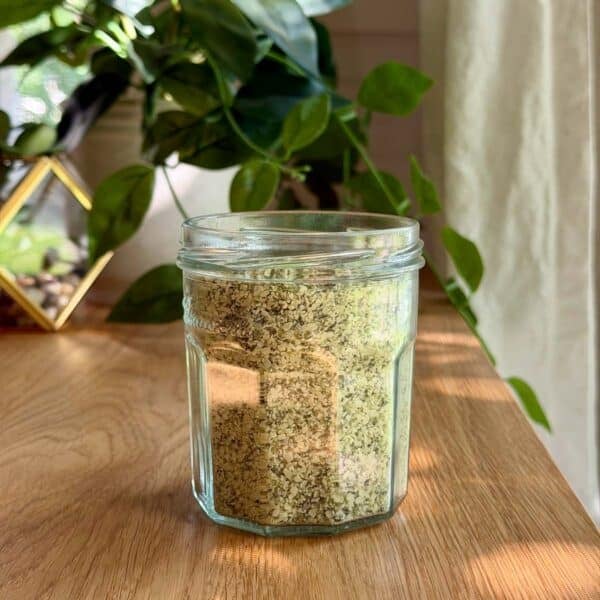
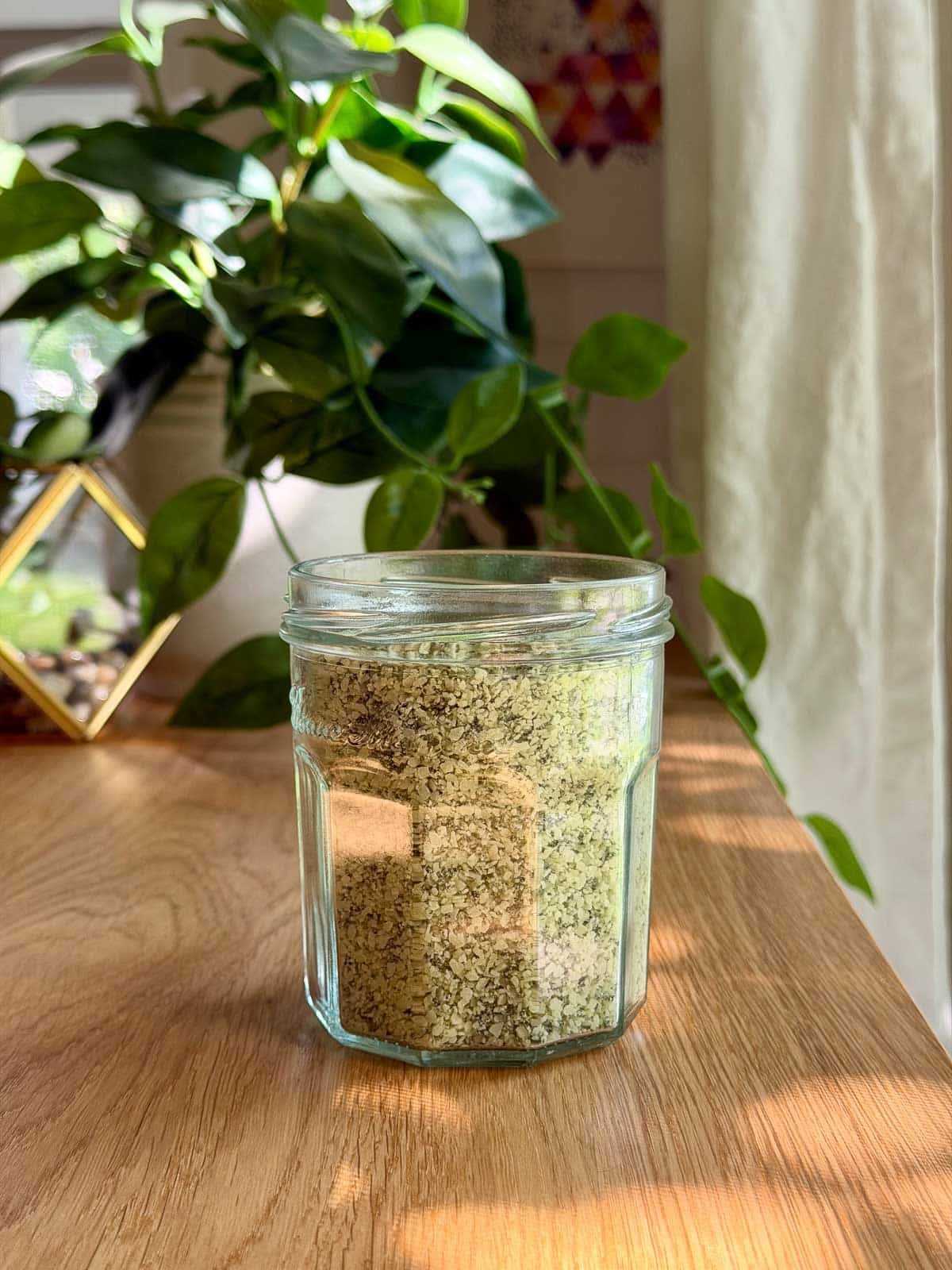
Once fully dried, the life span is more or less indefinite. We store ours in an airtight container and tend to use it before the next year’s basil is ready.
How to use basil salt
You can sprinkle this summery salt with abandon. If swapping it into recipes in place of regular salt, use about 1.25 times what’s called for. Some favorite uses:
- Ann Gratzer’s big green salad (coming soon!)
- Pan con tomate
- Sautéed zucchini and onions
- Chicken Caprese sandwich
Summarize & Save This Content On
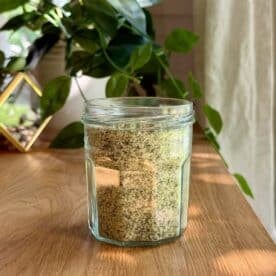
Basil Salt
Equipment
- Kitchen scale (optional, but really useful)
- Food processor (mine is 14 cups — it's okay if yours is smaller)
Ingredients
- 2 ½ cups gently packed basil leaves and tender stems
- 2 cups kosher salt, I use Morton
Instructions
- Wash the basil and dry it completely with paper towels. This step is important, so don't rush it. If you've got an extra day to let the basil dry thoroughly before proceeding, use that time. If not, that's okay.
- Add the basil to the food processor and top with the salt.
- Pulse until the mixture is a relatively uniform green. The salt should be fairly fine in texture, but not obliterated.
- Spread out the basil salt in a wide, flat baking dish that's not made of a reactive metal. (Glass, ceramic, or good-quality stainless steel is fine — avoid aluminum.) Cover with parchment paper and let sit on the countertop for several days, until thoroughly dried, stirring once or twice a day. As you can see from the video and process photos, the color will mute as the basil dries.
- Store in an airtight container at room temperature.
Notes
Ingredient notes
- This is a recipe to make when you’ve got plenty of fresh basil at its absolute peak. Since it’s the only real flavor, and crops can vary in so many ways, sample it and make sure you really like the taste of this particular basil a lot before proceeding. (If not, make pesto, which gives you a million levers to pull and adjust.)
- This recipe works best with kosher salt because it starts out fairly large and has a delicate structure than will break up nicely in the food processor. Both Morton and Diamond Crystal work just fine, but for reference, I used Morton when testing my favorite ratios of salt to basil. Due to their different shapes (and therefore how much salt fits into a cup measure), Morton is much saltier than Diamond Crystal when measuring by volume. If you’re not in North America and have a hard time finding kosher salt, I’d recommend a large, flaky sea salt, which should also break up nicely in the food processor without turning to dust.
Process notes
I really prefer to let basil salt dry at room temperature, since it preserves as much as possible of the herb’s complex flavor profile. If you have a dehydrator, you could use that instead on a low setting (max about 115°F/46°C). I don’t recommend drying basil salt in the oven, but if you must, keep it on the lowest setting, usually 200°F/93°C.Storage
Once fully dried, the life span is more or less indefinite. We store ours in an airtight container and tend to use it before the next year’s basil is ready.Nutrition
Nutrition information is automatically calculated, so should only be used as an approximation.








Can I make this with Himalayan salt and purple basil?
As long as you enjoy those flavors, start with a fairly coarse Himalayan salt, and use a strong food processor (since the salt is much harder to process than Kosher), it should be just fine! Let me know if you make it this way. 🙂
This looks delicious! I can’t wait to try it…thinking of adding some of my homemade garlic powder at the end
Love that idea, Amie!
What about using pink Himalayan salt? Thanks
Hi Carol, it wouldn’t be my first choice for either flavor (which has a lot more going on than Kosher salt) or texture (which tends to be either very coarse or very fine). That said, I’m all about people customizing my recipes to fit their needs, so if you do give it a try, please let me know how it goes!
Thank you love the recipe of basil salt
I’m disappointed; after referring to using weights as measures, you seem to provide only volumetric (I.e. cups) one. Am I missing something?
Hi Nancy, you did miss it, but it’s easy to. At the bottom of the ingredient list, toggle from U.S. customary to metric.
Hi! I was wondering if you have attempted to dehydrate the basil before pulsing with salt? I imagine it would have a different profile? In the raw, the basil oils infused with the salt? And maybe with dehydration first, the flavor is not as deep? I am guessing but would love to hear from you. Thank you!
Hi Sandra, I haven’t done that, but I think you are exactly right about what would happen. Letting all the fresh oils from the basil mingle with the salt while it dries together adds another layer of flavor that I wouldn’t want to miss out on. Thank you for that question!
What are the measurements by weight? I have a kitchen scale, but the only measurements I saw were in cups. I can’t wait to make this!
Hi Angie, I’m sorry it’s a little hard to find (I’m working on improving this!), but there’s a place at the bottom of the ingredient list where you can toggle between US Customary and metric. Metric will show you the weights!
ideas for using the basil salt please?
Hi Anne, there are some suggestions throughout the post!
Do you keep the stems as well as the leaves? Looks fantastic delicious!
Hi, Lindy! I only use the very tender stems attached to the leaves for basil salt. If you’re eager not to waste the stems, you could infuse them into some olive oil or even root and regrow them! I will admit I’m not in a phase of life with that much patience right now, but I have been at times in the past, and it’s lovely. xx